
Electrosoft System Electrosoft System

Embedded Systems Engineer

This 6-month job-oriented Embedded Systems course is designed to take a student from fundamentals of digital electronics all the way to deploying real IoT systems and industry-grade firmware. The curriculum covers all major microcontroller families — from classic 8051 and PIC to modern ARM Cortex-M series and wireless SoCs like ESP32. Communication protocols, RTOS, and Edge AI are covered with hands-on lab sessions every week. Students graduate with a portfolio of working projects demonstrating
6 Months All Levels Certificate Included
Embedded Systems Engineer

Course Overview

Program Overview
Target Job Roles: Firmware Engineer, Embedded Systems Developer, IoT Engineer, PCB Layout Engineer, Microcontroller Specialist.
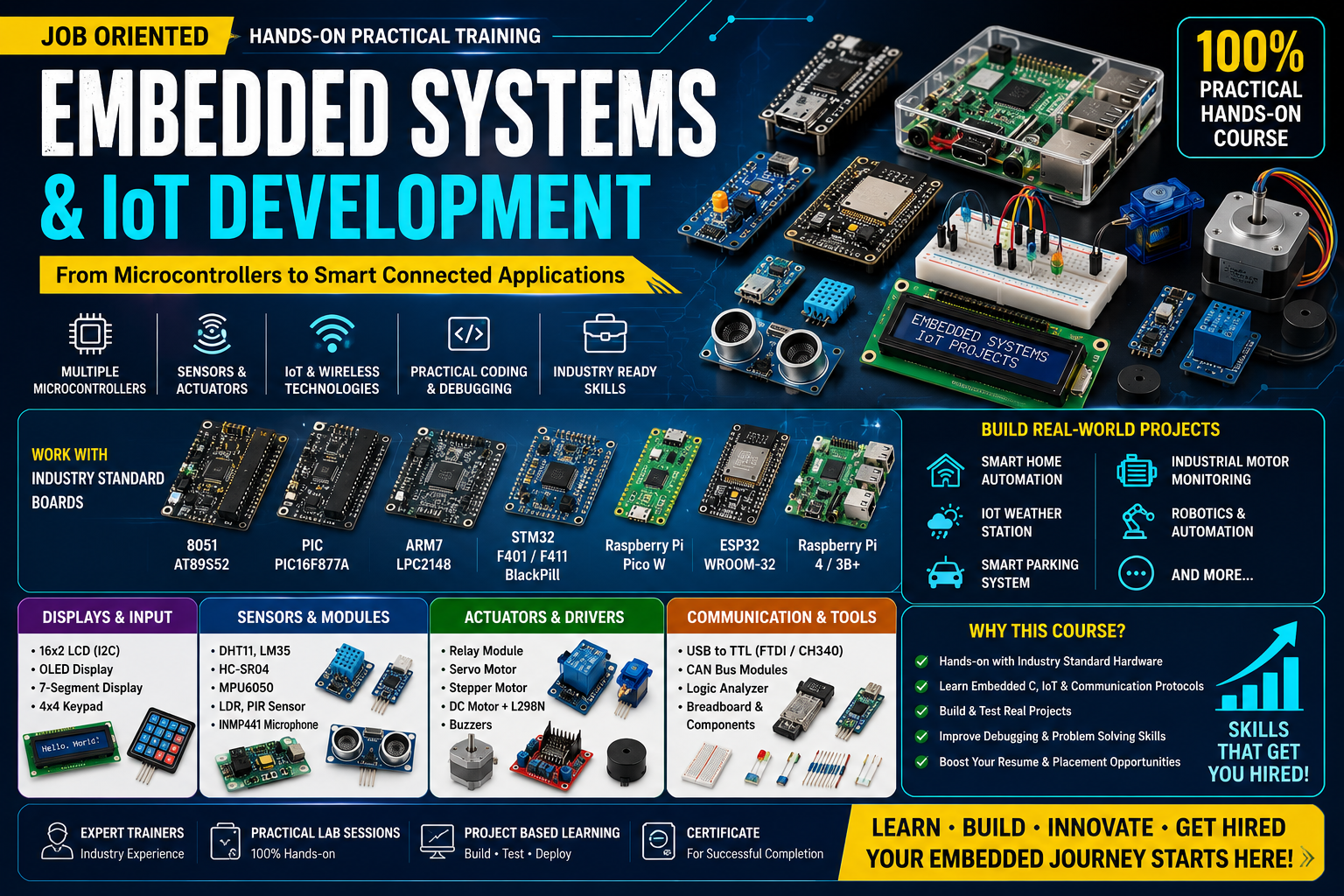
Core Hardware Architectures: 8051, PIC (PIC16/18), ARM7 (LPC2148), STM32 (ARM Cortex-M), RP2040 (Raspberry Pi Pico W), ESP32, Raspberry Pi 4/5.
Programming Languages: Embedded C, Object-Oriented C++, MicroPython/Python 3, ARM Assembly (Basics).
Core Tools & Suites: Keil uVision, MPLAB X, STM32CubeIDE, VS Code, Proteus VSM, KiCad EDA, FreeRTOS, Linux Terminal, Git.

Eligibility Criteria

DiplomaDuration: 3 years (after 10th grade) or 2 years via lateral entry (after 12th/ITI).Focus: Practical work and basic job skills.Outcome: Junior engineer, technician roles, or direct entry to the second year of a BE degree.
B.Sc. (Electronics, Computers, Physics)Duration: 3 years (after 12th grade).Focus: Science rules, lab work, and theory.Outcome: IT jobs, lab assistant, or further studies like an MCA or M.Sc.
BE (E&Tc, Computers, Electronics, Electrical)Duration: 4 years (after 12th grade).Focus: Advanced design, core engineering, and math.

Syllabus / Modules

  • 1ā”œā”€ā”€ Microcontroller Boards:
  • 2│ ā”œā”€ā”€ 8051 Development Board (AT89S52 / STC89C52)
  • 3│ ā”œā”€ā”€ PIC16F877A / PIC18F4550 Board with PICkit 3 Programmer
  • 4│ ā”œā”€ā”€ LPC2148 ARM7 Development Board
  • 5│ ā”œā”€ā”€ STM32F401 / STM32F411 BlackPill Board (with ST-Link V2)
  • 6│ ā”œā”€ā”€ Raspberry Pi Pico W
  • 7│ ā”œā”€ā”€ ESP32 WROOM-32 Dev Kit
  • 8│ └── Raspberry Pi 4 (2GB/4GB) or Raspberry Pi 3B+
  • 9│
  • 10ā”œā”€ā”€ Display & Input Modules:
  • 11│ ā”œā”€ā”€ 16x2 Character LCD (I2C Module included)
  • 12│ ā”œā”€ā”€ 0.96 inch I2C OLED Display (SSD1306)
  • 13│ ā”œā”€ā”€ 7-Segment Multiplexed Display Unit
  • 14│ └── 4x4 Matrix Membrane Keypad
  • 15│
  • 16ā”œā”€ā”€ Sensors & Modules:
  • 17│ ā”œā”€ā”€ DHT11 Temperature & Humidity Sensor
  • 18│ ā”œā”€ā”€ HC-SR04 Ultrasonic Distance Sensor
  • 19│ ā”œā”€ā”€ MPU6050 6-Axis Accelerometer & Gyroscope
  • 20│ ā”œā”€ā”€ LM35 Precision Centigrade Temperature Sensor
  • 21│ ā”œā”€ā”€ LDR Module & PIR Motion Sensor
  • 22│ └── INMP441 I2S Digital Microphone Module
  • 23│
  • 24ā”œā”€ā”€ Actuators & Drivers:
  • 25│ ā”œā”€ā”€ 5V Single Channel Relay Module (Opto-isolated)
  • 26│ ā”œā”€ā”€ SG90 Micro Servo Motor
  • 27│ ā”œā”€ā”€ 28BYJ-48 Stepper Motor + ULN2003 Driver Board
  • 28│ ā”œā”€ā”€ DC Motors (Geared) + L298N H-Bridge Driver Board
  • 29│ └── Piezo Active/Passive Buzzers
  • 30│
  • 31└── Communication & Tools:
  • 32ā”œā”€ā”€ USB-to-TTL Serial Converter (FTDI / CH340)
  • 33ā”œā”€ā”€ MCP2551 / SN65HVD230 CAN Bus Transceiver Modules
  • 34ā”œā”€ā”€ Logic Analyzer (8-Channel USB)
  • 35└── Breadboards, Jumper Wires, Assorted Resistors, Capacitors, LEDs, Multimeter

Trainer Information

Mr. Omkar

Mr. Omkar

Embedded System Trainer

3 years Exp Electronics Engineer| B.Tech E&TC @ GCOEJ| PG Diploma in Embedded Systems (DESD)@Sunbeam | Skilled

Benefits & Career Opportunities

Hands-on experience with real embedded hardware
Learn 8051, PIC, ARM, STM32, ESP32 and Raspberry Pi
Develop strong Embedded C programming skills
Learn sensors, actuators and motor interfacing
Practical experience with UART, I²C, SPI, CAN and PWM
Learn IoT and Wi-Fi-based applications
Develop hardware + software integration skills
Learn debugging using Multimeter, Logic Analyzer, ST-Link and PICkit
Build real-world industry-oriented projects
Develop problem-solving and troubleshooting skills
Create projects for resume and portfolio
Gain practical experience for technical interviews
Improve confidence in hardware and firmware development
Prepare for Embedded, IoT, Firmware and Robotics jobs
Bridge the gap between academic learning and industry requirements
Get exposure to product development and prototyping
Learn industry-relevant tools and development boards
Build job-ready Embedded Systems skills

Ready to Start Your "Embedded Systems Engineer" Journey?

Seats are limited for every batch. Apply now and our admissions team will guide you through the next steps.

Apply for Embedded Systems Engineer

Fill in your details below and our admissions team will get in touch with you shortly.