

Full stack development is the process of designing, developing, and maintaining both the front-end (client-side) and back-end (server-side) components of a web application. A full stack developer is skilled in creating user-friendly interfaces, building server-side logic, managing databases, and integrating APIs to deliver complete, end-to-end software solutions.
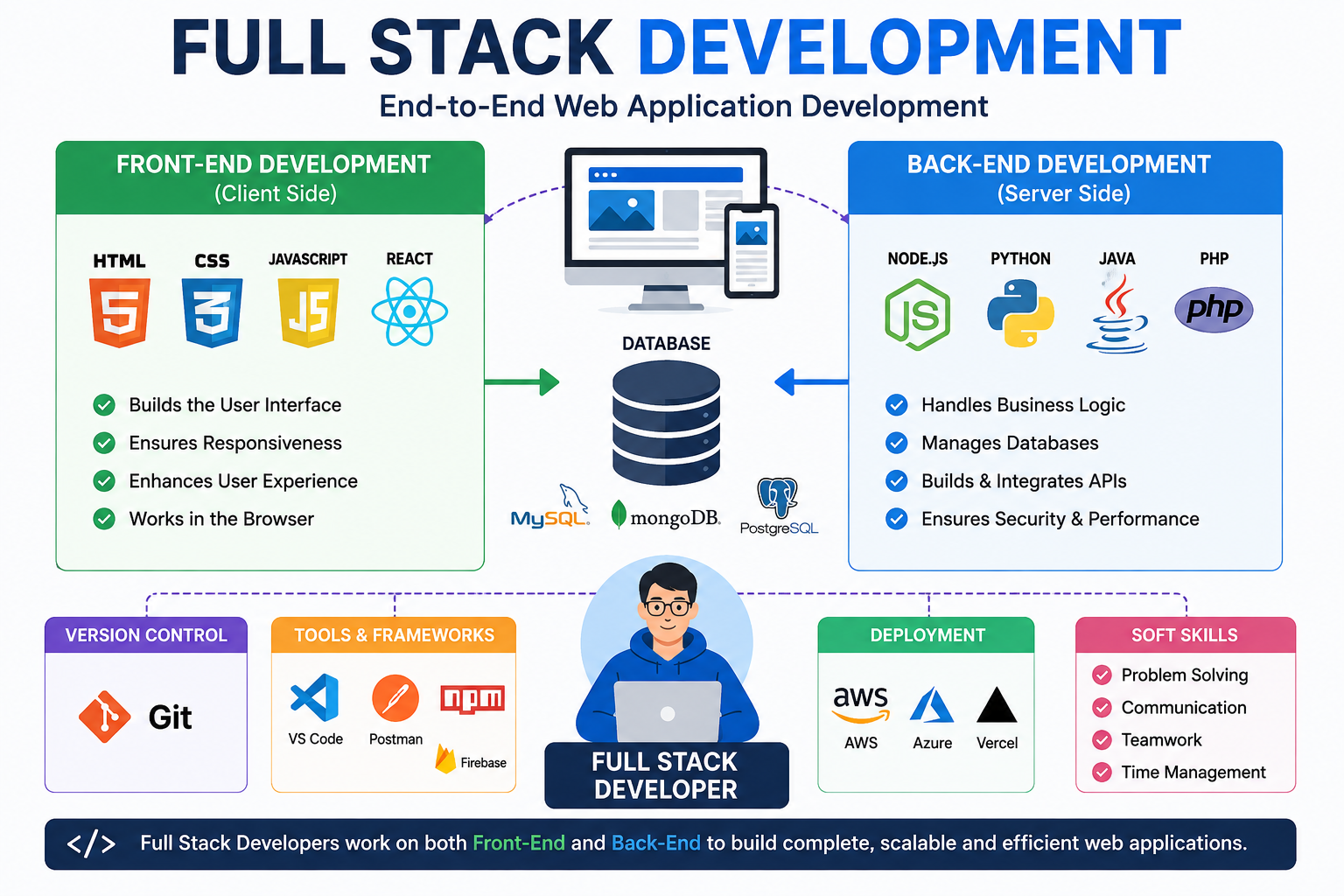
Full stack development is the process of designing, developing, and maintaining both the front-end (client-side) and back-end (server-side) components of a web application. A full stack developer is skilled in creating user-friendly interfaces, building server-side logic, managing databases, and integrating APIs to deliver complete, end-to-end software solutions.
A full stack developer typically works with technologies such as HTML, CSS, JavaScript, React, Angular, or Vue.js for front-end development, and Node.js, Python, Java, PHP, or .NET for back-end development. They also use databases like MySQL, PostgreSQL, MongoDB, or SQL Server, along with version control tools such as Git.
The eligibility criteria for learning or applying for a Full Stack Developer role generally include:
Bachelor's degree or Diploma in Computer Science, Information Technology, Computer Engineering, or a related field (preferred but not always mandatory).
Basic knowledge of programming languages such as JavaScript, Python, Java, PHP, or C#.
Understanding of web technologies including HTML5, CSS3, and JavaScript.
Familiarity with front-end frameworks such as React, Angular, or Vue.js.
Knowledge of back-end development using Node.js, Express.js, Django, Spring Boot, Laravel, ASP.NET, or similar frameworks.
The eligibility criteria for learning or applying for a Full Stack Developer role generally include: Bachelor's degree or Diploma in Computer Science, Information Technology, Computer Engineering, or a related field (preferred but not always mandatory). Basic knowledge of programming languages such as JavaScript, Python, Java, PHP, or C#. Understanding of web technologies including HTML5, CSS3, and JavaScript. Familiarity with front-end frameworks such as React, Angular, or Vue.js. Knowledge of back-end development using Node.js, Express.js, Django, Spring Boot, Laravel, ASP.NET, or similar frameworks.
Seats are limited for every batch. Apply now and our admissions team will guide you through the next steps.